Arjun and Wirebender

By Rick Harsch

That’s Arjun playing pool at Tom’s Bar and Grill in Galesville, Wisconsin, where Kneifl, Arjun and I stopped for lunch on the way down from the anticyclonic depression that swept through the brains of the northerners we escaped from, finding ourselves finally free and at ease after passing the last of the fracking sand mounds as the sun came out. But we were hungry and Kneifl against my initial objection insisted on leaving the main route so we could hit Galesville, where this early 20th century tavern sat two buildings off a square free of music and postwar architectural ideas. After we slant-parked I got out and saw a skinny guy that elsewhere would have been a heroin addict, but in a midwestern town is the alcoholic town mascot. “Call me Wirebender,” he said as we boarded the porch. “And tell that redhead in there that the Wirebender sent you. She’ll get pissed.”

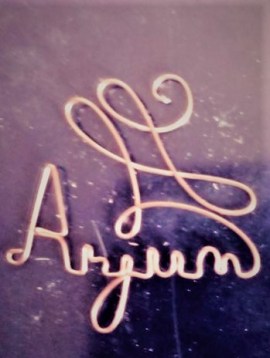
So we had lunch: mushroom swiss burgers and what has not hit Europe yet, hashbrowns, which was what I really wanted. And keep in mind we were in the northern rurals, mostly out of public sight, so I had no real idea what a couple geezers like me and Kneifl, unkempters from way back, dragging around a black kid like Arjun, might run in to–after all it was in just such a place stopping for lunch my pal little Tommy Franc’s girlfriend was handraped while they held him by the neck with his toes on the ground, which it to say it never hurts to wonder one way or another, especially when Wirebender came in and the redhead was pleasant with him, but a bit brusque to us. And Wirebender asked Arjun his name, not looking at me or Kniefl, just Arjun, who gave him the name which Wirebender got the spelling for, and came back in about two minutes with the copper label pictured below.

Before running into us, Wirebender had bent names for people from 36 states and six countries, so Slovenia made seven and we gave him names of girls from Czech and Italia and now he’s up to 36 and nine.

21729263_1468372999917134_210907779_n2      21733094_1468371963250571_1023412075_n

Huge themes and things that seem hard to do

By Chris King
Originally posted June 2013 at Confluence City

This morning Randall Roberts was musing that he wanted to share some music by Lydia’s Trumpet, one of St. Louis’ lost chamber pop bands, before anyone thought to name that quirky, at times precious, genre. Randall is one of our local music scenesters done good – he writes about music for the Los Angeles Times – so I wanted to hook him up.

Ray was not afraid to reach for the huge themes and statements, like interstellar distances, the origin and applications of petroleum, and wanting to make it with your girlfriend’s mom.

Lydia’s Trumpet – led by songwriter and chord strummer Ray Kirsch – was quirky, at times precious, clever but never smarmy, and at times unapologetically rhapsodic. Ray was not afraid to reach for the huge themes and statements, like interstellar distances, the origin and applications of petroleum, and wanting to make it with your girlfriend’s mom.

Ray was very warm and likeable as a person, and he made friends with the best rock and pop musicians in the St. Louis scene of the late ’80s and early ’90s, who all played together in The Lettuceheads.

His friends did that ace rock musician thing where they all played secondary or tertiary instruments to back Ray up, so Lettucehead frontman Mike Burgett was Lydia’s Trumpet’s nervy drummer, and the best piano and keys player in town, ever (Carl Pandolfi), played bass. I seem to hear Jon Ferber singing, but can’t picture him playing an instrument behind Ray.

Tim McAvin, not a Lettucehead, played his typical instrument (then) of electric guitar, but he had this magical way of standing there on stage absolutely puzzled by what he was playing or singing – because they all sang, drip, drip, drip, drip, drip, drip, drip, drip, drip dripping away around Ray. I remember Carl talking about Ray’s songs being like a child’s drawings, both erratic and beautifully simple, with an innocence the accomplished musicians who played them tried very carefully to protect.

To my knowledge, Lydia’s Trumpet made a cassette, Catalpa, a CD, Marmalade, and a 7 inch on Faye Records, Copernicus. I’ve kept up with most of these guys, and Burgett at some point made me a CD of the Catalpa songs that now survive in my collection only on a compilation I made of Catalpa and my favorite songs from Marmalade. My copy of Copernicus seems not to have survived one of my bouts of between-homelessness as a traveling rock musician.

The last time I saw Ray, I was going over some co-translations of Turkish poetry I was working on at the time, and after milking me for information about the project – he left the conversation equipped to write a chamber pop story song about Orhan Veli and Istanbul – he told me, “You’re always doing something that seems hard to do.” Then he left St. Louis to learn how to draw maps in Minneapolis. I’ve not heard of him for many years.

mp3s

from Catalpa
Lydia’s Trumpet

“Rocket to Mars”
(Ray Kirsch)

“93 Million”
(Ray Kirsch)

“Iowa”
(Ray Kirsch)

Loretta

By Todd Kimm

I have this scenario where I knock on her door one Friday afternoon and she doesn’t answer. I come through the unlocked door and hear the TV blaring, as usual. (I never pay attention to what’s on because everything in the afternoon is exactly the same.) I walk into the parlor and she’s lying there dead, her mouth hanging open.

This scene rolls through my head each Friday as I approach the house to pick up the news Loretta has collected of her friends and relatives’ comings and goings. Who visited whom. If they played cards. Who won the door prize. It’s a tradition the small community newspaper I work for has kept up. Loretta composes her news in longhand in a tattered spiral notebook and then types it out painstakingly on an old manual.

Now I stand on the threshold of her front room, the scenario having played out to a T, to find her sprawled on the couch. Panicked, I work to separate her from the let-go room. My eyes fumble for her stomach in the rash of flowers, flowers in the print of her dress and in the fabric of the couch. Finally I see her stomach swell and empty. I say her name a few times, each louder than the last. I think that maybe she’s had a stroke and fallen into a coma. I consider phoning one of the burly grandsons that live a mile away in each direction, waiting for something like this to happen. I say her name really loud and she jerks awake. She looks around startled, toward the TV, saying, “What, what?” I say it’s me, Todd, the paper man.

We fall into our usual routine. She complains about the pain in her foot. She wants a copy of last week’s paper. I race to my car to get one before I have to watch her struggle for the kitchen to find the type-written pages. I have already seen her dead sleeping and helpless waking; I don’t want to see her straining for the kitchen in deep burning pain for a handful of visits almost no one will read.

I return with the paper and she’s sitting in the kitchen chair out of breath. I sit in my usual chair and she asks me if I’ll pull off one of her stockings. This is new. Flesh colored and made out of the toughest wool, it must encomb her inflamed leg or do some good for her ulcerated foot. She wobbles her leg in front of me and I try to grasp the lip of the stocking. I brace myself for some awful smell or sight. The sock peels off coolly. Her leg is bony but not terrible. It could be a younger woman’s. She thanks me profusely. Says her grandson was there this morning and made her put it on, doctor’s orders. Getting it off is such a relief, she says. It just holds everything in and it all goes inside. Now it is let out. I notice her neck. The skin is almost pink. Her little grey curls are wet against her neck. “It’s a bone that sticks out on my toe,” she says. “I’m going to have to have an operation. I told Flora I just wanted to cut it off, but then that would hurt too.”

Loretta says her shoulder is bothering her too. She calls herself stupid for farming for so many years. Filling barns with hay each year. “I was just stupid,” she says. “The smart people are dead.”

I ask her if she is taking anything for the pain. She reels off three or four things she takes and even thrusts a dark brown bottle at me. She says she doesn’t like to take the pills. “It’s hell to get old,” she says. “You have to take a carload of pills.”

I can see Loretta was getting uncomfortable. The novelty of having been released from the stocking is wearing off. She needs to be released from something else. Maybe me. Usually a visitor in Loretta’s home feels a need to break off conversation and escape into the world through the kitchen door, but today it feels as if she is trying to break me off. It’s a hot day. Maybe she wants to be alone so she can take off her dress; deeply stained with suppers and blued with wear, it must be oppressive. If I were her grandson, I would offer to take it off over her head. It would be a pleasure to see her grateful relief.

Before I left that day, Loretta told me a story she’d heard or read about two boys who were swimming in a zoo after the zoo had closed. The pool was located in a containment for bears. “They just tormented and tormented those beautiful bears until one of them started to bite,” she explained. The boy being bit screamed and screamed, but that just made the bear bite harder. She ended the story with the image of the boy’s legs lying there untouched. I reasoned that the bear had either reached his fill or deemed the legs unfit.

“Those youngsters are just into too much trouble,” Loretta said. “The other one went home and never told no one.” I related my horror and disapproval at the boys’ behavior and prepared to leave. She blessed me as I left, made me promise to pray to St. Anthony for her.

And I think after I leave, all day this woman will dream of being eaten by a huge cool bear, and it will not leave her legs.
Whitecaps!

By Todd Kimm

After a feast of fruit sliced up in organic yogurt and thick slices of homemade banana bread we drove to a pine grove north of town. Brett made me listen to hear the trees talk, their language. “What are they saying?” I asked, playing along. So much of being with Brett was playing along.” Whoossssh,” he said, and “Shhhhhhhhhhaaaa.”

He kept trying to get me to agree to live in the house he planned to build on the piece of land he bought from his brother. I’d pay the utilities and live there for free. I suggested we use timber and pine from my childhood house to build a new one but he insisted that wouldn’t be economical.

We drove to the path that leads to Squire Point. Brett remembered running down the path with his high school buddies. “Once we got our jeeps stuck out here and it took us three days to get them dug out,” he said. The Point was a place where boats could come in close. The high school kids would come tearing down the path in the moonlight and just run straight off the Point and into the water. Swim out to the boat for an all-night kegger. This was also where years later Brett and Kathy had picnics, where they drank a bottle of wine and then made love. He kept pointing out spots where they’d done it, drank a bottle of wine and made love. Afterward they washed and soaked in a part of the creek they dammed with rocks to create a pool.

We got out to Squire Point and sat there devouring plums and oranges. It was windy. “Whitecaps!” Brett cried. “Whitecaps on fucking Lake MacBride!” I asked him what a squire was. A peasant who owns land, he said. He asked me what the rock we were sitting on was. I said I didn’t know. “Coral,” he said. “This was all a coral reef. Why do you think they call it Coralville?” We started back and Brett related how he used to tell Kathy he’d build her a house on the opposite shore. “I’m such a failure, he said. Brett had followed Kathy out to California where she had a good job and he looked. It was everything he could have wanted. He had it made, but threw it all away when, in a moment of weakness or fear, he cheated on her.

“You’re not a failure,” I said. “You experienced all that.” A hundred times more than me, I thought. But he wouldn’t believe it. He was worried about his heart, a second artirial block, self-diagnosed from his EKG, like when he snuck a look at his chest x-rays and diagnosed himself with late-stage lung cancer a few weeks before. “I’m just going to Africa,” he had promised. “No one’s going to bag up my shit and piss.”

Now Brett was looking for the ruts where the jeeps got stuck. This was like 20 years ago. Worn away, he concluded disappointedly after we finally found the spot where he thought it had gone down–although he claimed to be able to see some remnant of the event in how the trail softened at a certain rise. A ghost. Brett had come out here with Corbin–his second lost love, but this time through no fault of his own–a few years ago. That was the first time he had been back since, been willing to brave it without her.

Going up the hill, Brett’s chest was hurting and mine was too a little. He decided the only solution was to press on harder and then at the top of the hill, hollering he’d meet me there, he burst into a thundering sprint for the car.