Regarding darkness and my Dad’s horse

By Lisa Hannon

Last night I discovered my parents’ neighbor had left a message regarding Dad’s horse, whom he’s feeding while they’re out of town. She’s not been doing well since Sunday, and yesterday evening he couldn’t get her up, let alone into the barn. He thought she’d probably be okay till morning. But then he just ha-a-d to say, “I don’t know what will happen if a pack of coyotes finds her.”

Well, crap. I got in the car and drove through the starry countryside to the farm. Here’s how big a chicken I am: I was in tears because I was scared of how scared I was going to be when I got there. I’d asked a couple friends to come along, and they weren’t keen on the idea, so I was going alone to do… what? Sleep on the grass beside the horse? Fight off coyotes with my bare hands? I think a lot of things are getting to me right now and I feel utterly helpless to ease the suffering in the world, like the pain my friend Dave is in while dry heaves rack his frail, cancer-eaten frame, and the suffering our upcoming war with Iraq will bring.

I pulled into the pitch-black yard and left the headlights on, pointing past the barn. The darkness was hugely silent and thick with stars, and as I found a path through the long grass to the gate, I could hear water dripping off the barn into a tall patch of nettles, and it sounded like the echo of someone hitting a baseball. Some of the weeds were over my head, and I walked down through the shadowy barnyard and out into the pasture, until the bobbing circle of flashlight picked out the buckskin stripe of a large, plump horse lying on her side. Uh oh. But then–bless her–she hove onto her feet and stood. Her backside was aimed towards me as if to kick should I come too close. I know next to nothing about horses, but this was an encouraging development. I did not think my wavering courage extended to exploring the yawning farm buildings for a rope, but I did cast my flashlight beam ‘round the barnyard to see what might be out in the open.

Eyes. There were brilliant, gleaming eyes in a tall stand of weeds across the cement yard. I strode quickly in that direction, expecting the eyes to disappear and the thing to slink away like a ‘possum or raccoon would. But they stared me down. “HAH!” I shouted, thinking to myself that I wouldn’t be scared of me, either. I made out a long, grayish form, too large to be a cat, standing silently and watching my approach. This ridiculous plastic flashlight was not going to be any use if I needed a weapon. Just then the eyes disappeared. Not a sound, not a rustle of movement in the weeks, but they were gone.

I exhaled. Somewhere in the next field, you could hear a soft squealing and grunting, just on the edge of hearing if you strained. I’d read some director of thrillers, possibly the director of “Signs,” quoted that it builds anxiety when the audience isn’t sure whether they heard something or what it might be if they had. I could personally attest to that dynamic right now. No, I don’t think seeing “Signs” would have helped me one bit.

I went into the dark house, turned on several lights and tried again to dial my dad, getting busy signal after busy signal. Finally, at 11:30 p.m., the phone rang and there was my dad’s comforting voice of optimism, telling me to go home. He didn’t think the coyotes would hurt the horse, and she should be fine until I reached his veterinarian in the morning. A part of me wishes I’d had the guts to sleep next to the horse that night, but I almost leapt at my dad’s advice. I didn’t even turn the yard light off because I couldn’t handle walking back to my car in the black of night. I felt anxious and exhausted.

As I crossed the lighted circle of gravel, a sudden loud shriek tore the stillness. “Oh, Jesus!!” I cried. This time it was clearly raccoons, squabbling in the branches above my car, trilling and squealing and making my heart shake as hard and fast as the leaves beneath them.

I drew in a breath and laughed at myself, but locked my doors as I drove away past the towering, silent corn.

Part 2

I met the veterinarian the next day, and he gave the horse a shot of vitamins and painkillers. As I write this years later, I no longer remember what he said in response to my fearful question of whether my dad’s old horse had reached the point she should be put out of her misery. I think he acknowledged she was on the downhill slide, but the injections would make her easier, and we could see how it went. Neither do I remember why I made another visit with my friend Linda, when the neighbor who’d first called lived so close and we didn’t. Maybe I’d offered to relieve him, since the easy favor he’d agreed to do had morphed into a more stressful responsibility.

Linda, whose own horse was in the prime of his life, burst into tears when she saw my dad’s elderly pet lurch to her feet and stand trembling, balanced on the edges of her hooves. Her knee-jerk reaction was to suspect my father of neglect. My tears were quieter, and the reason that Dad would probably rather I hadn’t been involved: I’m a worrywart with a tender heart, and a tendency to see things as worse than they are. No doubt it was a balancing act for him to gauge the horse’s condition through the long-distance lens of me; he also didn’t know that the neighbor was privately almost as worried as I. When I asked him if I should have the vet put her down if she was suffering, he said a loud “NO,” and was adamant that he would be the one to do it if it became necessary. He’s not usually stern with me, but this horse had been part of his life for decades. Please, God, help her, I thought, because Dad is five days out and there’s no way I can leave her suffering. But at what cost to our relationship? What if he didn’t get to say goodbye because of my decision?

Linda decided, on further reflection, that she wasn’t accustomed to older horses and the situation wasn’t as dire as it had felt, just heartbreaking to see an animal enduring pain; still, she dreamed about her that night. The vet called at 8:00 p.m. to say he’d given the horse a sedative, and she might sleep. Because I’d called the Department of Natural Resources the preceding day, and the guy who answered supposed it was possible coyotes would attack a horse if they thought she was on her last legs – which they might if a sedative had knocked her out – I headed for the farm after my desk job. Sometimes you just gotta do something because you’d kick yourself the next day if it went wrong because you hadn’t.

It was again dark as I drove down the lane, which was like a tunnel formed by the steep embankment on the left and the Autumn-high corn on the right, and turned into the barnyard. The asphalt around the old gray barn was cobbled now, season after season of Iowa frost having expanded and contracted it, so I inched along with the light from my headlights bouncing from the barn roof to the asphalt to the trees beyond the barn back to the asphalt, and then onto thick grass, where I accelerated to keep moving into the pasture. The horse was still awake, and didn’t seem to mind a vehicle pulling in beside her. The night before, it hadn’t occurred to me that I didn’t need to doze on the grass exposed: I could sleep in my car. I switched off the headlights, reclined my seat and listened to soft music on the radio for awhile, breathing the sweet smell of horse and hay until I was sleepy, then turned off the car, rolled up the window most of the way and let crickets be my lullaby.

I dreamt my ex-boyfriend realized he’d made a mistake and still wanted me. It had hurt every day without him, and I was just on the verge of kissing him when I remembered he was married now and woke with a start. It was 3:00 a.m. Darkness, softness, bright starlight registered on my awareness. I’d forgotten how you can see in the country night like it’s deeper day, or a bedroom-lit blue. The chorus of insect song was dense enough to touch. I could see the shadowy form of the horse, still upright after the shot the vet had given her. In fact, she was walking, slow and faltering, but walking all the same, and she could reach the ground now to pull grass. The soft tearing and munching sounds came closer in the darkness.

I got a pan of water from the barn, no longer afraid of shadows, and held it for her while she drank. Maybe somewhere inside me a horsewoman does sleep, because I could have stood there a long time breathing in that wonderful horse fragrance and understanding viscerally the closeness my dad felt to this large, gentle animal.

In the morning when I opened my car door, she neighed at me and it was better than the sunrise.

Lisa Hannon was born in Cedar Rapids and still calls Iowa home, even though she’s fallen in love with her adopted city of Portland. She earned her BA in English from Iowa State University, and, like many English majors, has held a variety of jobs, including bar-tending, flipping burgers, answering a switchboard and dissecting rat brains. She is a professional “hugger,” having learned from the best of them, Amma, India’s “hugging saint,” and rockstar of the Free Hugs movement, Ken Nwadike Jr. Now she combines blogging with hugging on her Facebook page, HUGS HERE Portland.
 

Stuck here forever, with you

By Amanda Coyne
This piece originally appeared in the first issue of Little Village magazine, July 2001

I give him a look. “OK, OK. Detroit,” he admits, “I was born in Detroit.” I decide to discontinue the questions. But he continues the answers: “And don’t forget about the time I sailed across the Pacific on a homemade boat, with two complete strangers.”

“I’ve heard this story, Gary.”

“How about the time Bob Novak sat in on the ‘Sanders Group?'”

That gets my attention. But because I want to talk about Robert Novak, and not him, he gets coy: “But you’ll just have to watch it, now, won’t you?”

“How about the times I hitchhiked across the country?” he offers. “You want that story?”

“Gary. This piece is about me and about being in Iowa City, still, and about January and about getting old. It’s not about you. You’re just a backdrop, just a foil, an excuse. This an excuse to write about me.”

Excuses he understands, and they shut him up, for now. He picks up a newspaper, and I commence to staring out the window of Gary Sanders’ latest temporary endeavor: formerly Freshens Yogurt, now temporarily The Best of Books, The Worst of Books. He opened it, he told the papers, because he couldn’t stand to see another business in downtown Iowa City’s pedestrian mail shut down. But all who know Gary know he just wants an excuse to be downtown during the days in winter, and he can’t quite reconcile himself to being a public library catnapper. Besides, he’d have to be quiet in the library. And he’s not a quiet man.

Once, years ago, when we were both in love–me with a greasy masseuse, him with a Hawaiian honey–we danced in the parking lot of the Kirkwood Learning Center where we both worked, and he, wearing shorts with dress shoes and mismatched socks, sang “Love Train” at the top of his lungs.

He puts down his paper and bellows, “On January 21, at 12:30 pm–are you getting this down?–I hereby declare that I, Gary Sanders, am a genius!” He takes off his glasses and heaves a the-world-is-too-much-for-a-man-such-as-I sigh.

“Did you get that down?” he asks.

“On January 21, at 12:32 p.m.,” I read from my notebook, “I hereby declare that Gary Sander’s is a big stupido.”

He considers. “Is that how my obit’s going to read? ‘Gary Sanders. Big Stupido. Dead?”’

“How about this? ‘Gary Sanders. Iowa City rabble-rouser, gadfly, talk-show host, owner of weird bookstore, man of mysterious means, general aggravation, Big Stupido. Dead.'”

He smiles. He likes that. He’s obsessed with New York Times obituaries. He has several of them taped haphazardly on the walls, their headings screaming against a backdrop of cheery white-and-red tiles, posters of yogurt cones and yogurt sundaes topped with cherries and nuts:

“Rupert C. Barneby, 89, Botanical Garden Curator and Expert on Beans, Is Dead.”

“John S. Mollison, Scholar, 87, Rebuilt Lost Greek Warship, Died.”

“AI Gross, Inventor of Gizmos with Potential, Dies at 82.”

“It won’t be long,” he sighs. He’s getting morose; and so I’m glad when a man enters the store carrying an empty watering can in one hand, a stack of flyers in the other. I pick up Mao’s “Little Red Book,” and, in my best Marilyn Monroe imitation, purr, “Reading is so sexy. I just love a man who reads.”

I am middle management for the day. My job is to sell the books. My reward is a piece of Lindts chocolate I spotted in Gary’s “briefcase”–his omnipresent, grease-stained box filled with old newspapers; old political flyers announcing old protests; dirty paper coffee cups; half-wrapped, half-eaten mysterious things.

“Cut it, Amanda,” he says, and pointing to the man with the watering can: “Friend.”

Gary’s friend informs him that tomorrow there will be a rally protesting Bush’s inauguration. The day after tomorrow, a second rally will protest sweatshops. The day after, nuclear energy. Apparently, a few aging white men will be spending all winter on the street comer, freezing, getting angry, holding signs, looking like they are rehearsing for a Midwestern “Monty Python.”

They start talking McGovern. I tune them out and stare out the window at Jim Leach’s office across the way. For the 20 or so years I have called Iowa City my home, I have never, ever seen anybody come in or out of that office. But they’re in there, I know. Behind the drawn shades, I imagine evil things transpiring: deals are being cut with corporate hog-lot owners, ethanol subsidies are being slashed, a man named Abraham is sacrificing his firstborn.

“Weird things are happening over there,” I say after the friend leaves. “Can’t you feel it? The energy, Gary, can’t you just feel it?”

A few years ago, Gary would have played along. His eyes would have gotten wide, his face taken on an exaggerated, conspiratorial grimace. He would have said, “Corporate welfare.”

Me: “Prayer in schools.”

Him: “Jew Bashing!”

Me: “Clitorectamies.”

But he’s grown out of Amanda games. And sometimes the look in his eye lets me know that I should too. My presence seems more often to exhaust than uplift him. Now, mostly he looks at me and shakes his head. “I grow old,” he says, when I try.

Once, years ago, when we were both in love–me with a greasy masseuse, him with a Hawaiian honey–we danced in the parking lot of the Kirkwood Learning Center where we both worked, and he, wearing shorts with dress shoes and mismatched socks, sang “Love Train” at the top of his lungs. We even got the welfare mothers, the high-school dropouts, to join in.

But he’s changed since those years–actually, since he came back from Hawaii with a lei and a frown. Although when summer comes he will inevitably still be loping after fleeing coeds, a mass of papers in hand, a zealot’s look in his eyes; ever since his public-access television show, “Who Wants to Marry a Short, Middle-aged Cranky Guy with No Money?”, failed to fetch him the shiksa of his dreams, he seems for the most part to have given up on love.

These days, Gary, in his middle age, is interested in getting down to business. “Down to business,” he reads from his horoscope. “The time has come to resist temptation and get down to business–are you writing this down? The time has come to resist temptation and get down to business.” He raises his hands in the air and yells, “Halleluiah. Praise the Lord.” I do not shush him, because his preacher’s voice is preferable to some of his others. Down to business. The phrase runs through my head, and all and all, it doesn’t sound too bad. Preferable to what most of us in this tiny dot of a town in the center of the country have been doing. Preferable to staring out at a gray January day waiting to catch a glimpse of a real-life Iowa City Republican. Suddenly, a fourth-grade teacher is in my head, and she’s telling me to “Take the bull by the horns,” and that ”Today is the first day of the rest of your life.” “Wake up and smell the coffee,” she says. Another voice, this time with a jeer, says, “Shit or get off the pot.”

My body begins to vibrate, my legs want to move. I want things–something, anything–to happen. I want to sell a book.

“Enough of this!” I say. I pick up a copy of Dennis Rodman’s Bad as I Want to Be, jump on the ledge and thrust my hip out in a model’s pose. When a group of boys walk by, I mouth, “Uh, ah, reading is soooo sexy.” One of them stops, stares and mouths back with real concern, “Is something wrong? Do you need help?”

“Good job,” Gary says.

“Gary!” I jump off the ledge and run my hands frantically through my hair. “Why don’t we create a marketing plan, get a small-business loan, apply for one of those tax-relief thingamajigs. We could actually do something. We could make a go of this.”

I’m having a vision. It’s the bookstore/coffeehouse of my dreams. I see plush couches and leather binding. I see a place where people actually converse. I see poets talking iambs with politicians. I see career criminals and starving artists embracing. I see myself having a scintillating conversation about French literature with a mysterious man.

“Upper management will consider your ideas,” Gary says. “But in the meantime, why doesn’t middle management begin by organizing the books?”

I look around at the 300 or so ratty books arranged in no discernable order–What to Expect When You’re Expecting next to Great Expectations. Danielle Steel next to Dante. Wally Lamb next to Charles Lamb. A wave of exhaustion runs through me. I sit down and resume staring out the window, this time at Hawkeye World Travel, from which perky, tanning-boothed blondes bounce in and out constantly. I look at the recently deceased and papered Treasures knickknack store. It’s sad when a store with such a blithe name goes under, even though I always felt sympathy for the farmers’ wives who’d stumble upon the store–while doing Christmas shopping, say, or before the Iowa/Iowa State Game–scratch their heads and say under their breath, “Don’t people have better things to do with their money?” “Gold-plated roses? Giraffe-shaped coffee mugs? Elephant snout vases?” “That’s different,” they’d say, as they handled a bronze com cob infused with a grenade pin.

But that, of course, has always been one of the things that separates Iowa City from its state. We are different. We are the types of people who buy such things, and we are proud of it. And we–the best and the worst of us–are the types of people to always buy books.

Or maybe not any more. The ped mall’s awfully empty these days. Maybe now we’re buying our picture frames at Target, ordering our books online. I’ve been here for two hours, and the only people who have entered looking for anything other than yogurt are Gary’s friends. And either they’ve given up on books because they read somewhere years ago that literature is dead (they’ll tell you so with a knowing look, a touch of feigned sorrow in the shrug of the shoulders), or it’s their books that Gary’s peddling.

Partly because she’s pretty, partly because he’s incapable of reserve, it’s too much for him. He stands up suddenly, knocking over a chair, and on his way toward her trips over a table. He’s coming at her, arms pinwheeling, head in a matador position. She takes a few quick steps back with a horrified look on her face.

We are also within spitting distance of the anti-fountain fountain. There’s something vaguely depressing about that fountain, even in the summer. The way the water refuses to return into the holes, and instead clops on the marble like a herd of horses, making bricks slick, causing children to fall and cry, adults to yell over the noise, and the guy strumming some awful rendition of “Sugar Magnolia” to strum even louder. But in the summer, despite all the cacophony, there’s still that air that glides across the skin like a silk shirt, there’s the deep shadows and the Disney-blue sky and the whiff, occasionally, of earth; the smell that reminds us that this world is being nourished by the land around us, and that despite Steve Atkins or R.J. WinkIehake, good things are happening here.

But in the winter, everything feels doomed in that Greek tragedy kind of way, when an infraction against the gods (the killing of Eric Shaw) ensures that all the money and energy and good intentions in the world will not bring about a workable fountain, kiosks with telephones and newspapers, or keep Iowa City–the treasure of Iowa–from dying.

Or maybe it’s just me. Maybe it’s the frostbitten January sky, the post-holiday blues, the dirty snow and the sallow complexions. Or maybe it’s the fact that once you reach a certain age–mid-30s apparently–optimism takes a certain kind of energy that belongs to the perky blondes who, on the first day of the semester, are already planning spring break in Cancun at Hawkeye World Travel.

A college-aged woman enters. “A customer!” I whisper to Gary.

“A customer!” He repeats. “A real one!”

She browses. Gary and I sit, very silently, for a while.

“Stay cool, Gary. Just keep it cool.”

Partly because she’s pretty, partly because he’s incapable of reserve, it’s too much for him. He stands up suddenly, knocking over a chair, and on his way toward her trips over a table. He’s coming at her, arms pinwheeling, head in a matador position. She takes a few quick steps back with a horrified look on her face.

“Hello!” he bellows, after he rights himself. “My name is Gary Sanders, and she … ” he says pointing to me, “is my middle manager, Amanda Coyne. Let us know if we can help you.”

She continues to browse. He moves toward her. She moves away.

“If there’s anything at all we can do for you…”

“I’m just looking,” she says and picks up a copy of Ann Tyler’s Ladder of Years.”

“How much?” she asks.

Gary leafs through the book. “Let me see,” he says. “A hard copy? Published recently? Let…me…see…” he places one finger on the side of his temple and taps. “So, what do you do.”

“Five dollars,” I tell the girl. She reaches into her backpack for her wallet.

“Hold on,” he says. “Just one second. Her wallet goes back into her backpack.

“She,” he says, pointing to me, “is just middle management. Just hold it right there. These are difficult times. Middle management be running around giving product away. For you though, today and only today, I’ll sell you this fine book for 218 dollar and 30 cent.” Now he’s stumbled into some kind of mutant ped-mall slacker voice. “218 dollar and 30 cent.” The girl chuckles nervously. She begins to slide toward the door.

“Now seriously. You look like a nice young lady. What is it you say you do?” She’s getting scared. She’s halfway out the door. “Seven dollars,” he yells at her back. “Seven dollars is my final offer. Take it or leave it. Today and today only.” She escapes.

*

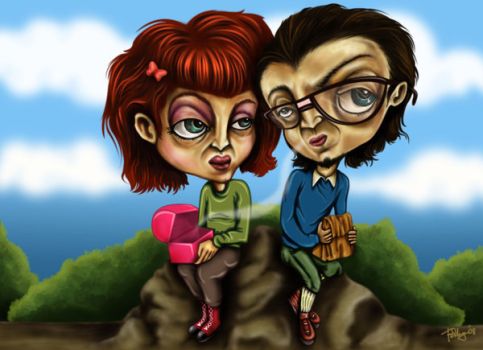
‘Tm depressed, Gary,” I say. ”I’ll never get out of this town. Nothing will ever happen and I will never leave. I’ll be stuck here, with you, forever. Can I have that chocolate, please?”

”You sell a book, you get the reward,” he answers. “Has anyone ever told you, by the by, you be one high-maintenance girl? You be all the time need some attention.” This is punctuated with a homeboy pointing of the finger; a downward movement of the arm; a short, intellectual, radical leftist imitating Dr. Dre.

But that’s not his worst. His worst is his hillbilly impersonation. And this he commences with a whooping, “Hey Bubba,” when Larry Baker, Iowa City’s number-one Southern-writer boy enters. Let me rephrase that. Larry Baker does not just come in, he struts in, in the way that a New York TImes best-selling author struts. Or maybe I’m projecting. Maybe I’m just imagining myself walking into a little used bookstore after such a success.

Introductions are made, and I–just like any other wanna-be writer in this town–pretend to only have vaguely heard of him and his book. He tries to talk to me, but I answer in monosyllables and become interested in the life of Malcolm X.

This might be the only town in the world where nobody will like you if you become a famous writer.

They start talking McGovern. I stretch and yawn and think deep thoughts. I think about how downtown Iowa City is doomed: how it will never get a Gap or J Crew or Ann Taylor. I think about no matter how many times it changes ownership, loud, bad muzak will always blare out of the old Holiday Inn’s loudspeakers. I think that no matter the money I spend at Dombies, I will never look like one of the girls who work there. I think about how the Englert will inevitably become a sports bar, and about how those of us who don’t frequent such places will forever spend our days caffeinated and frustrated at the Java House of sexual repression.

I am brought back by Gary yelping, “Ya’ll come back now, you hear?” at Baker’s back.

During my reverie, someone has added black streaks of charcoal to the dusky sky and cranked this spot on the earth a notch away from the sun.

The mercury’s dropping, fast. Tonight it’s going to be a cold one. The wind’s gotten louder and has taken on the cry of a lonesome child. Later, it will become a madwoman’s screech. Everywhere, blinds are being drawn, furnaces are kicking in, bundled children are walking away, fast, from school. College students are wondering why they didn’t choose a university down south. Farmer are cursing their forefathers for not making it farther west. Halos of light surround lampposts, storefront windows are fogging, and everybody, including Gary and me, is heading home.

Gary adds more old newspapers to his briefcase, wraps up his half-eaten sandwich and turns off the lights. We stand outside the shop for a moment. He is wearing his pile cap and a down coat that reaches his feet. His glasses are spotted and fogged, and his gloves don’t match. I have a nearly overwhelming desire–archetypal almost–felt by hundreds of Iowa City women since that fateful day in 1977 when he disembarked off a Greyhound bus–to hoist him over my shoulder, take him home, feed him and clean him up.

I start singing: “Gary, Gary Sanders, King of the Iowa City ped mall.”

“There you go,” I say, “Gary, there’s your obit ”

“Cheer up,” he says. ”This place ain’t so bad. Besides, spring’s right around the comer.”

We part ways and walk toward the warmth. Toward home. He is humming his obit. I have a hand in my pocket, fingering my stolen piece of Lindt’s chocolate.

Amanda has an MFA from the University of Iowa in creative writing. For many years she reported from Alaska, covering everything from crime, to the arts, to the outdoors. She’s been a stringer for Bloomberg, The New York Times, and a contributor to Newsweek. She’s been published in many other publications, including Harper’s and The New York Times Magazine.

The Wolfes

I grew up in a house at the heart of the bachelor cluster. At the time, no one saw a pattern. It was only later, after the murder, the sheriff started his map with the colored pins.

The farm was known as the Old Wolfe Place long after my grandparents bought it. I pictured the gray old things ripping apart a deer carcass in the corner as I crunched my tater tots at the kitchen table.

They became people later, of course, through stories my grandmother told.

The Wolfes had one daughter, Gertie. She would age into a character worthy of tall tales, but first she was the victim of a father who would not let her date. His filibuster ended when she was nearly through her teens. The boy who came wore a boutonnière and the snowball bush was in full roar. The only problem… her dad wanted to go along. Gertie never got asked out again.

Did the spinstership of Gertie Wolfe carry the germ of the Benton County bachelor epidemic? If there is a science of loneliness, is it a chemistry or a biology? Maybe it’s a meteorology, something caught up with the clouds. I only know that I have been a student all my life.

Gertie’s first cousin, Millie, lived in the house just down the road. Millie’s only child was Frank, the most proximate bachelor.

Frank died of MS in his early 30s. I remember him always driving by real slow in his copper-colored Chevy van, at first to keep from coating his prized possession with dust, and later because that was all the faster his disease would let him go.

About a mile south the ground started to roll and the bachelors started turning up in pairs. Red and Evelyn Broom raised two bachelors. Jim was tall and skinny, with the proverbial shock of red hair. He had a flinty face with freckles and acne scars. I remember the kids on the school bus called him “fossil face” behind his back.

His younger brother Dave was more of a looker, with a lot of floppy ‘70s hair. He dated many girls, but we heard, could never seem to stick with one for long.

The father, Red, would on Christmas Eve make the rounds as Santa Claus. I remember his costume being unbearably old-fashioned, frayed and rubbed shiny in places, especially the rosy/chubby cheeks of the plastic mask. He brought us oranges and apples. But we never ate fruit. Brownies and “coon turd” cookies were what our palettes had grown to love and demand. But there was more to distain about the innocent Santa. By the 1970s, no one showed up at one’s door unannounced. It just didn’t happen. And if someone dared to break that third wall of nuclear family bliss, they would be shot (with many apologies after the fact, of course) or laughed off the place.